
The Art / 03 / Belts & progression
PROGRESS
WITH PURPOSE.
Understand the ranks. Respect the time. Keep your attention on the work.
A belt is a beginning.
A belt makes progress visible, but it cannot summarize everything about a practitioner. Technical understanding, the ability to apply it against appropriate resistance, safe judgment and steady improvement develop at different speeds. This guide separates the IBJJF’s recognition rules from the broader work of learning jiu jitsu.
These are federation recognition requirements, not a newly announced Oddfellows promotion policy. An instructor assesses a student’s development; IBJJF decides whether a rank meets its conditions for federation recognition. The two questions are related but different.
| Rank | Minimum federation age | Standard minimum before next rank and educational focus |
|---|---|---|
| White | No separate minimum stated | No prescribed minimum Learn the positional map, safe movement, tapping, basic escapes and how to train responsibly. |
| Blue | 16 | 2 years before purple Build reliable escapes and a working guard and passing game. Connect a small number of useful attacks and defenses against appropriate resistance. |
| Purple | 16 | 18 months before brown Link positions, solve unfamiliar reactions and develop a more adaptable personal game. |
| Brown | 18 | 1 year before black Refine timing, transitions, positional control and the ability to correct recurring technical weaknesses. |
| Black | 19 ordinarily; 18 for the qualifying Adult brown World Champion | Black belt degrees follow a separate activity and recognition system A substantial foundation for continued study, with responsibility for technical judgment, safety and the example set for other students. |
At 16 and 17, white and blue have no minimum time. Purple cannot progress to brown until the Adult division; the applicable adult purple exceptions must then be checked. Adult minimum periods are measured from completed IBJJF registration at the rank, not simply the club’s ceremony date (Articles 3.1.2 and 3.2.1).
IBJJF age = current calendar year minus birth year. For IBJJF, a student born in November 2010 is 16 throughout 2026. Federation age categories do not dictate Oddfellows class groupings or establish a youth class offering.
Official basis: Articles 2, 3 and 6
The exceptions matter.
| Current belt | Qualifying prior registration or achievement | Minimum time at that belt |
|---|---|---|
| Blue | Prior IBJJF registration as grey, yellow or orange 3.1.3 II b | 1 year |
| Blue | Prior IBJJF registration as green 3.1.3 II c | No minimum time |
| Blue | Prior IBJJF registration as Juvenile blue 3.1.3 II d | No minimum time |
| Blue | Adult Blue Belt World Champion 3.1.3 II e | No minimum time |
| Purple | Prior IBJJF registration as Juvenile blue 3.1.3 III b | 1 year |
| Purple | Prior IBJJF registration as orange or green AND as Juvenile blue 3.1.3 III c | No minimum time |
| Purple | Prior IBJJF registration as Juvenile purple 3.1.3 III d | No minimum time |
| Purple | Adult Purple Belt World Champion 3.1.3 III e | No minimum time |
| Brown | Adult Brown Belt World Champion 3.1.3 IV b | No minimum time |
The standard minimums are eligibility floors, not targets for every student. A professor still assesses readiness. Prior youth color alone is insufficient for these adult time reductions: the document specifies completed IBJJF registration history.
Imagine an adult earns blue after an unspecified white-belt period and is then eligible under the ordinary minimums: two years at blue, eighteen months at purple and one year at brown. That is four and a half years after blue plus the unspecified white-belt time. It is an eligibility example, not a forecast, a normal average or a promise. Most importantly, the professor must still judge readiness at each step.
Official exception references
Decades of continuing work.
| Degree | Cumulative qualifying black belt activity | Belt |
|---|---|---|
| 1 | 3 years | Black |
| 2 | 6 years | Black |
| 3 | 9 years | Black |
| 4 | 14 years | Black |
| 5 | 19 years | Black |
| 6 | 24 years | Black |
| 7 | 31 years | Red and black |
| 8 | 38 years | Red and white |
| 9 | 48 years | Red |
These are cumulative years of proven black belt activity recognized by IBJJF, not years since the first jiu jitsu class. Degree applications also involve certification requirements. The document describes 31 years at black, seven at red/black and ten at red/white as fixed rank periods, while Article 4 gives the degree recognition activity milestones. Neither should be presented as automatic promotion by a calendar.
IBJJF counts qualifying years supported by active membership, registered academy professor status, approval of students’ memberships, prior certification, championship titles, referee/rules certification or recognized substantial contribution. Years without qualifying activity are not counted. The first activity and certification requirements have additional conditions; refer to Articles 4.2 and 5 for an individual application.
Current advanced minimum ages are 49 for seventh degree, 56 for eighth and 66 for ninth in this edition. These age floors do not replace the required activity and certification process.
Historical tenth degree
The IBJJF records tenth-degree red belt as a historical recognition of Carlos, Oswaldo, George, Gastao and Helio Gracie. It is not listed as an ordinary next milestone for current ninth-degree holders.
Official basis: Articles 2, 3, 4, 5 and 6
Thirteen ranks. Many individual paths.
There are 13 youth ranks. The colored families open at federation ages 4, 7, 10 and 13, with no universal minimum time at a belt. Eligibility is permission to be assessed, not an automatic promotion. This resource does not announce Oddfellows children’s classes.
The long white or black center band is part of the youth belt’s rank color. It is not an advancement stripe. The illustrations show a black end bar with no advancement tape; shades vary among manufacturers.
White family
Starting rank
White
Grey family
Eligible from age 4
Grey / white
Grey
Grey / black
Yellow family
Eligible from age 7
Yellow / white
Yellow
Yellow / black
Orange family
Eligible from age 10
Orange / white
Orange
Orange / black
Green family
Eligible from age 13
Green / white
Green
Green / black
Advancement tape is a different marking.
Illustrative tape on the short end bar. This is separate from a full-length rank band.
White through brown may use up to four degrees under the professor’s chosen approach. Stripes do not create an automatic entitlement to the next belt.
Official basis: Articles 2, 3 and 6
The year a student turns 16.
| Rank before age 16 | Juvenile / adult ladder at 16 |
|---|---|
| White | May remain white 2.2.3 I |
| Grey family | Must enter blue 2.2.3 II |
| Yellow family | Must enter blue 2.2.3 II |
| Orange family | Must enter blue 2.2.3 II |
| Green family | Blue or purple at professor’s discretion 2.2.3 III |
The age-16 rank conversion and the later adult time reductions are different rules. For reduced adult periods, the PDF specifically requires earlier IBJJF registration at the named ranks. Retain registration history and check the precise pathway rather than assuming every former youth belt receives the same waiver.
Three suggested ways to mark progress.
Quarterly
Every 3 months
Three advancement degrees, then a fourth milestone to the next belt. The illustrated schedule spans one year. It is an optional model, not a required youth waiting period.
Triannual
Every 4 months
Two advancement degrees, then a third milestone to the next belt. Triannual means three times a year here, not once every three years.
Monthly
Every month
Eleven advancement degrees, then the twelfth milestone to the next belt. The first four degree markings are white, the next four red and the last three the next belt’s color. Follow the illustrated replacement scheme rather than drawing eleven pieces of tape side by side.
Optional first two belts
Monthly examples for white and grey/white
Annex I also illustrates six months at white and six at grey/white within one year. This is a suggestion, not a mandatory six-month promotion promise.
Official basis: Annex I suggested youth models
What actually earns a belt?
General educational guidance, not an official Oddfellows grading contract. Different instructors weigh these factors differently, and individual limitations matter. The useful question is what you can understand, apply and improve safely over time.
Understand positions
Recognize guard, passing, pinning and back control. Know what you are trying to achieve before chasing a technique.
Apply skills against resistance
Use escapes, guard retention, passing and submissions with training partners who are offering appropriate, controlled resistance.
Connect and adapt
Respond when the first idea fails. Link positions and notice how timing, balance and reactions change the problem.
Train consistently and thoughtfully
Repeated practice matters, but attention and correction matter too. Attendance creates opportunities to learn; it does not buy a rank.
Protect the people beside you
Control submissions, respect taps and limitations, and choose intensity that allows both partners to keep training.
Demonstrate growth over time
A coach can compare decisions, understanding and effectiveness across many sessions, rather than judging a single tournament or one unusually good roll.
Winning can reveal useful information. So can losing, escaping a position you once feared or helping a new student train safely. A belt is not awarded simply for attendance, a medal, four stripes or an anniversary.
Good questions. Clear answers.
Does reaching the minimum age or time mean I am due for promotion?
No. Federation eligibility is a floor for recognition, not an appointment for a belt ceremony. The professor still assesses readiness. Some students need more time, and the minimum rules include registration and youth-history exceptions.
Are four stripes an automatic ticket to the next belt?
No. The IBJJF describes four degrees for white through brown, but adoption through brown is the professor’s choice. A stripe is feedback within a training system; it does not override technical readiness or guarantee the date of the next belt.
Why does my child have a white or black line down the belt?
In the youth system that long center band is part of the rank itself. Grey/white, grey and grey/black are three different belts. Small tape markings across the short end bar are advancement stripes and serve a different purpose.
Must every child spend six or twelve months at each belt?
No. The IBJJF sets no universal time minimum at youth belts. Its monthly, quarterly and triannual methods are optional teaching models. Their suggested one-year examples are not mandatory waiting periods.
What changes in the year a student turns 16?
IBJJF moves that student into its juvenile/adult belt ladder. White may remain white; the grey, yellow and orange families move to blue; green may become blue or purple at the professor’s discretion. This is a federation rank classification, not a statement about which Oddfellows class a student should attend.
Does IBJJF age change on the birthday?
No. Its age is the current calendar year minus the year of birth. A student born in November 2010 is 16 for the whole 2026 competition year. An academy may organize classes differently.
Do previous youth belts affect adult minimum times?
They can, but the document specifies prior IBJJF registration, not simply having worn a belt. Registered grey, yellow or orange history reduces the standard adult blue period to one year. Registered green or Juvenile blue history removes it. Purple has additional pathways explained in the exceptions table.
Can someone become a black belt at 18?
Under the June 2026 system, an athlete who has won the Adult World Championship at brown belt can be recognized at 18. Nineteen is the ordinary effective minimum for other athletes. A general tournament win, a Juvenile title or a Masters title is not this exception.
Does winning Worlds waive every rule?
No. The Adult World Champion exception removes the minimum time at the champion’s blue, purple or brown belt. It does not erase age, registration, certification or other recognition requirements.
How many years does a black belt really take?
There is no universal completion date. Training history, consistency, coaching, injury, age and individual development vary. A hypothetical timeline is only an illustration. Adding the standard minimum periods together does not produce a responsible prediction for a new student.
Do black belt degrees arrive automatically as the years pass?
No. IBJJF degree recognition depends on qualifying documented activity and its certification process. Years without one of the recognized activities do not count toward certification. The cumulative activity milestones are 3, 6, 9, 14, 19, 24, 31, 38 and 48 years.
Is the tenth-degree red belt a normal promotion goal?
No. The official document identifies it as a historical award to Brazilian jiu jitsu pioneers Carlos, Oswaldo, George, Gastao and Helio Gracie. It supplies no ordinary modern progression period from ninth to tenth degree.
Are these Oddfellows promotion rules?
This page explains the federation framework and general coaching considerations. It does not establish a new Oddfellows promotion policy. Ask your instructor about personal development goals and local assessment.
Does this youth guide mean Oddfellows offers children’s classes?
The youth section is an educational reference for students and parents. Current class offerings are those on the club’s live schedule; this page does not announce a children’s program.
Does a higher belt make a training partner safe to ignore?
No. Everyone must respect taps, communicate limitations and control intensity. Rank should bring greater responsibility for the people sharing the mat.
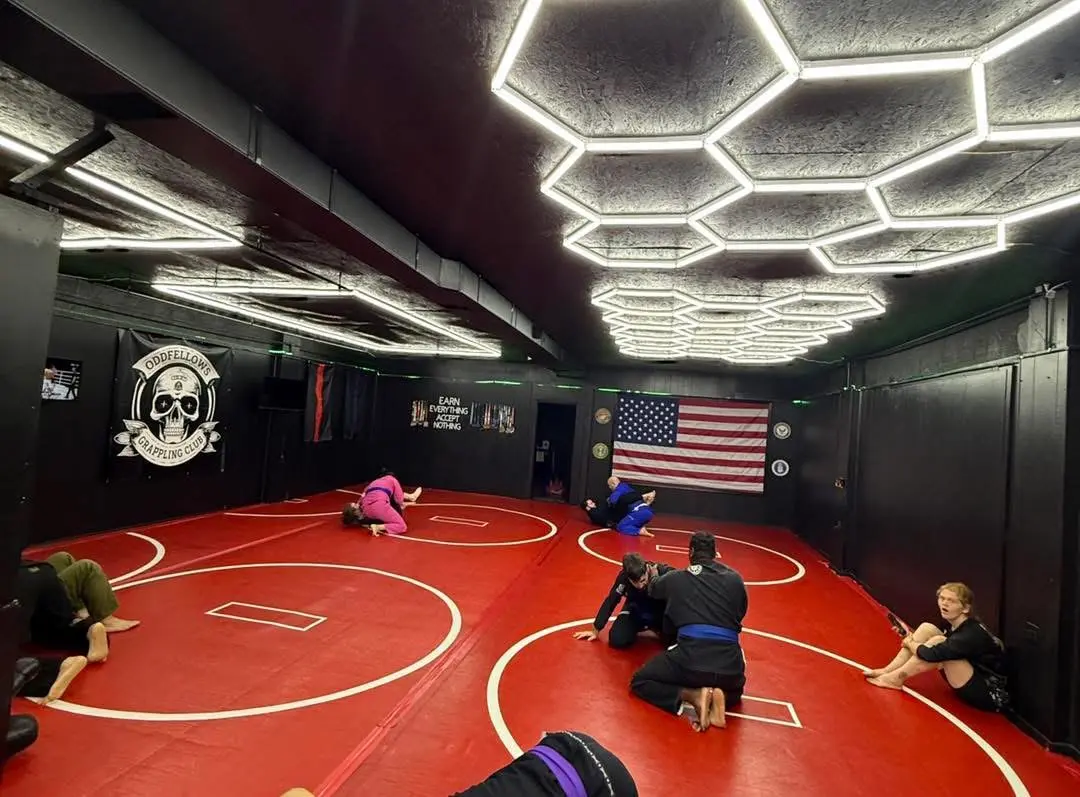
Oddfellows / Established 2024
The next useful question is yours.
Ask your coach what to improve, which position needs attention and how to train that skill responsibly. A thoughtful conversation can give the next round a purpose.