
The Art / 02 / Our lineage
KNOW WHO
PASSED IT ON.
Respect for our teachers begins with representing their relationships accurately.
Teachers, not trophies
Trace the connection.
Read the qualification.
What reaches the Oddfellows mat today passed through many hands. Some connections are documented rank relationships. Others describe instruction, family development or an institution’s influence. Keeping those categories visible is part of respecting the people in the story.
This is a record of instruction and historical influence. It does not imply that any person shown personally endorses Oddfellows or has taught at the club.
Reading from the Japanese origins toward Oddfellows.
- 1860 to 1938 / Kodokan founded 1882
Jigoro Kano
Earlier Japanese jujutsu schools → Kano: study and synthesis, including Tenjin Shin’yō ryū and Kitō ryū.
Evidence: Historical institutional influence.
Biography and contributions
Kano established Kodokan judo by reworking earlier Japanese jujutsu traditions into an educational practice. This is an institutional starting point, not evidence that every later judoka was personally promoted by him.
Contributions: Kodokan judo. Randori and kata within a broader educational method.
- 1878 to 1941 / Brazil from 1914
Mitsuyo Maeda
Kano’s Kodokan → Maeda: institutional training. No personal promotion by Kano is asserted.
Evidence: Documented institutional connection.
Biography and contributions
A Japanese Kodokan judoka whose demonstrations, contests and teaching helped carry Japanese grappling across borders. His Brazilian teaching circle matters to the story, even when the exact student relationships require qualification.
Contributions: International demonstrations and contests. Transmission of Japanese grappling to Brazil.
- Early twentieth-century Belem
Jacyntho Ferro
Maeda and Ferro: Brazilian teaching circle. Drysdale’s research identifies Ferro among Maeda’s Brazilian students.
Evidence: Attributed historical interpretation; Oscar/Carlos identification qualified.
Biography and contributions
Drysdale’s historical research identifies Ferro as a prominent Brazilian student and teaching associate of Maeda. A period report names Oscar Gracie as Ferro’s student; Drysdale interprets that person as probably Carlos. The precise identity and extent of training should remain qualified, and the traditional direct Maeda and Carlos account should not be drawn as an undisputed belt promotion.
Contributions: Early Brazilian instruction. A necessary qualification to simplified family trees.
- 1902 to 1994
Carlos Gracie Sr.
Ferro → Carlos: instructor relationship proposed in Drysdale’s reading of period reporting; the Oscar/Carlos identification is an inference. Maeda → Carlos: traditional direct teaching account remains disputed. Neither is shown as a verified black belt award.
Evidence: Early teacher relationship disputed.
Biography and contributions
A central organizer and teacher in the Gracie family’s early development of jiu jitsu. His importance does not require treating the traditional Maeda teaching story as settled or overlooking other Brazilian schools.
Contributions: Academy teaching. Gracie family organization and dissemination.
- 1913 to 2009
Helio Gracie
Carlos and the early Gracie circle → Hélio: family instruction and collaborative development, not an asserted modern belt ceremony.
Evidence: Documented teacher of Royler; earlier family transmission broader.
Biography and contributions
A major teacher, challenge fighter and public advocate within the Gracie family tradition. His connection with Carlos represents family instruction and shared development, not a modern certificate chain projected backward.
Contributions: Teaching and public demonstrations. Transmission to later Gracie generations.
- Brazilian and international competition era
Royler Gracie
Hélio → Royler: black belt received from his father, according to Royler’s teaching biography.
Evidence: Primary biography.
Biography and contributions
Royler learned within the family academy and received his black belt from his father Helio. A four-time World champion and three-time ADCC champion, he provides an important link between Gracie Humaita teaching and international sport competition.
Contributions: Gracie Humaita instruction. Success in gi and no-gi championship formats. Technical books and instruction.
Source references
- Rio de Janeiro to Phoenix / late twentieth century onward
Wellington “Megaton” Dias
Royler → Megaton: documented instructor relationship in Megaton’s academy biography. A specific awarding ceremony is not established here.
Evidence: Primary academy biography; original award details unconfirmed.
Biography and contributions
Megaton’s academy identifies him within Royler Gracie’s Gracie Humaita tradition. It also records earlier training with Rogerio Camoes, a reminder that a diagram can summarize a principal relationship without describing every formative teacher. His long career connects Brazilian instruction with an enduring American academy and generations of competition.
Contributions: Gracie Humaita transmission to the United States. Long-term teaching in Phoenix. Decades of gi and submission grappling competition.
Source references
- American academy and international competition era
Jack McVicker
Megaton → McVicker: black belt relationship documented in McVicker’s official academy biography.
Evidence: Primary academy biography.
Biography and contributions
McVicker’s own academy identifies him as a Brazilian jiu jitsu black belt under Megaton. Based in the Midwest, he combines an extensive competition background with full-time teaching. His place here is also a reminder that the art’s American growth depended on regional instructors who created places to train consistently.
Contributions: Midwestern academy development. Competitive instruction. Teaching adapted to individual students.
Source references
- Training from 1999 / St. Louis teaching community
Kyle Watson
McVicker → Watson AND Megaton → Watson: parallel reported black belt instructor relationships in the published 2015 interview. Exact awarding arrangement unconfirmed.
Evidence: Published interview; exact awarding arrangement unconfirmed.
Two teachers. Two documented relationships.
Megaton → Jack McVicker → Kyle Watson
Megaton → Kyle Watson
The first path records McVicker’s own lineage. The second preserves Megaton’s separately reported relationship with Watson. Neither path supplies an unverified promotion ceremony, date or sole promoter.
Biography and contributions
Watson began martial arts while attending the University of Illinois and later built a career across Brazilian jiu jitsu, MMA and teaching. His academy biography verifies his role as owner and head instructor of Watson Martial Arts and his UFC experience. A 2015 interview identifies him as a black belt under both Jack McVicker and Megaton and describes the different lessons he learned from each. Those are parallel relationships, not a reason to invent a single-file chain or a promotion date.
Contributions: St. Louis instruction. Integration of grappling and MMA experience. Teaching and development of regional instructors.
Source references
- Riverbend instruction / Strategic BJJ founded 2019
Keith Steinacher
Watson → Steinacher: black belt under Watson, documented in Steinacher’s first-person public profile.
Evidence: First-person public academy profile.
Biography and contributions
In his Alton Main Street profile, Steinacher identifies himself as the owner of Strategic BJJ and a black belt under Kyle Watson. He describes bringing the art to Riverbend practitioners. This is the immediate teaching relationship connecting Andrew’s instruction with the wider lineage. The same profile mentions TAC Team separately as an affiliation; affiliation is not inserted into the promotion ancestry.
Contributions: Riverbend teaching community. Strategic BJJ academy leadership. Andrew Carr’s instructor, as reported by Andrew.
Source references
- Oddfellows Grappling Club / established 2024
Dr. Andrew Carr, D.C.
Steinacher → Carr: second degree brown belt, confirmed by Andrew. Owner reported; no independent federation certification claim.
Evidence: Owner reported.
Biography and contributions
Andrew is Oddfellows’ volunteer head instructor and a second degree Brazilian jiu jitsu brown belt under Keith Steinacher. His purpose is to give back to the community through careful instruction, training and the development of confident, capable people. His teaching emphasizes technical understanding, attention to detail and a game that works against real resistance.
Contributions: Volunteer instruction. East Alton community training. Family, Dedication, Strength.
Source: Andrew Carr, owner provided rank and Head Instructor information, confirmed in the October 2026 website instructions.
Photographs: Andrew’s approved portrait appears on the existing Head Instructor section. Other instructor photographs are omitted until separate reuse rights are established. Names and original biographies carry the information here.
Meet Andrew and the Oddfellows coaches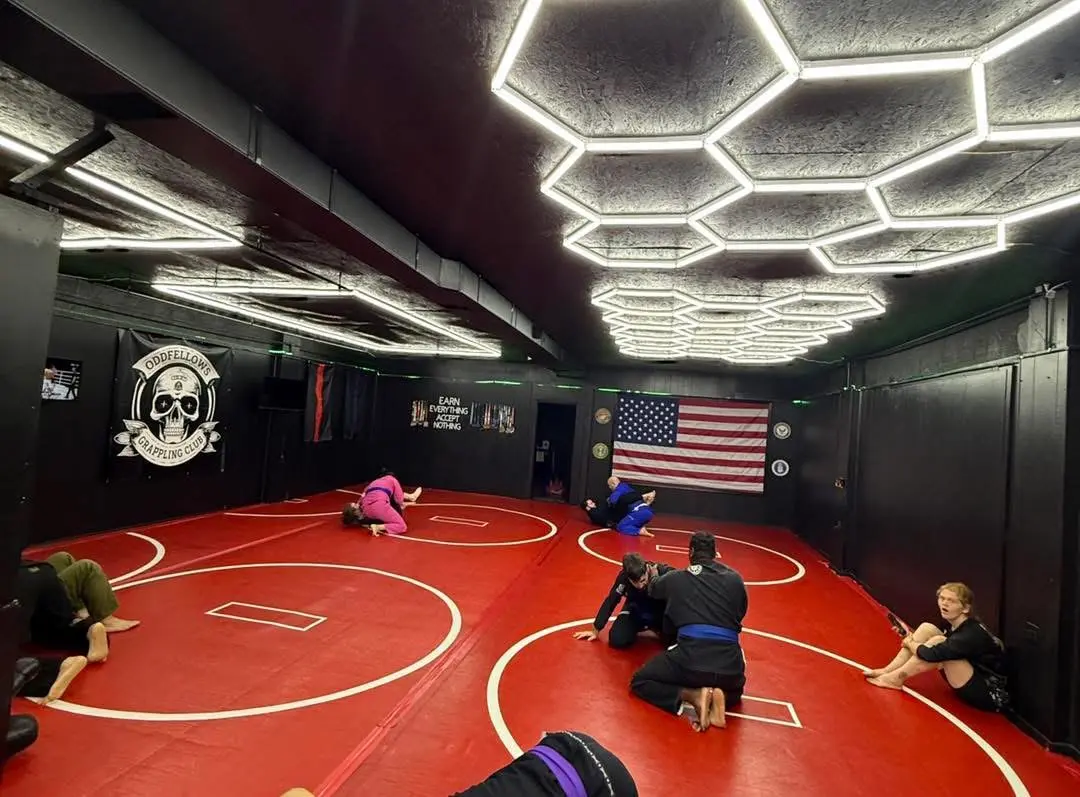
Oddfellows / Established 2024
The next responsibility is ours.
Lineage gives us people to thank. It also gives us work to do: keep learning, test our understanding, teach carefully and help the person beside us improve. Family means the people matter. Dedication means showing up willing to learn. Strength means becoming more capable while taking care of the room. That is how an inheritance becomes a living practice in East Alton.